
You sent a message. No reply. You read it again, check whether you said something wrong, go back over the last time you saw each other. Then you start drafting what to write to clear things up, even though you don't yet know whether there is anything to clear up.
Half an hour later you have gone through a lot of possibilities. The information you have, though, is exactly what you had before.
That is what overthinking feels like: working on a problem non-stop without getting one step closer to a solution. The good news is that psychology has precise tools for this, and some of them you can start using on your own.
What overthinking is
“Overthinking” is an everyday word, not a diagnosis. Psychology studies two more precise processes: worry, which is mostly about what might happen, and rumination, which goes back over what has already happened, over mistakes and over what they say about us.
They have one thing in common: they feel like a way of solving the problem, but at some point they stop producing new information and carry on anyway.
One question is enough to spot them: after thinking about it, have you understood something new, or are you still where you started?
What keeps the loop going: reassurance seeking
One ingredient feeds the loop more than any other, and it is the one that looks like the cure: seeking reassurance. Rereading the message for the umpteenth time, asking a friend “do you think they're upset with me?”, checking whether the other person is online.
Each bit of reassurance brings real relief, but it does not last. And it teaches the wrong lesson: that to feel calm you need certainty. Since certainty almost never arrives, the need comes back, a little stronger than before.
That is why, in cognitive behavioural therapy, work on repetitive thinking also means cutting down on reassurance, not finding better sources of it.
What the research says
A meta-analysis published in 2025 in Psychological Medicine by Stenzel and colleagues pooled 55 randomised controlled trials with 4,970 participants to measure how much cognitive behavioural therapy reduces repetitive negative thinking, worry and rumination included.
The result is a moderate effect compared with control groups, and a stronger one when the intervention was built specifically around these processes: targeted approaches worked better than general ones.
These are findings about cognitive behavioural therapy, not about AI chats. But they say something important: thinking that goes round in circles is not a personality trait you just have to put up with. It is a precise target, and working on it pays off.
Three exercises for when you can't stop thinking about it
You don't need to tackle every thought at once. Start with one recent episode, just one.
1. Separate what you know from what you imagine. Go back to the unanswered message. The fact: “I wrote two hours ago and haven't had a reply yet.” The interpretation: “They don't want to hear from me any more.” Written one under the other, they make visible a step that felt automatic in your head. Then you can ask yourself what supports the interpretation and what other explanations are possible.
The aim is not to convince yourself that everything will be fine, but to reach a sentence that sticks closer to the facts: “This wait worries me, but right now I don't know why they haven't replied.” It is the thought-checking technique the NHS suggests in its self-help CBT resources.
2. Look for a possible action. Ask yourself whether there is anything concrete you can do. For a work worry, that might mean preparing a document or asking for clarification: in that case, choose one step and decide when to take it. If there is nothing to do right now, recognising that is already progress: going on thinking about it does not give you more control, it just drains your energy.
3. Give your worries a set time. The NHS suggests worry time: ten or fifteen minutes a day to write your worries down and look for possible solutions. When a thought comes back outside that time, you note it down, postpone it to that slot and return to what you were doing. At first it only half works: it is a habit you build with practice.
Can an AI chat help with overthinking?
Yes, if you use it to put things in order rather than to get certainty. The difference lies entirely in what you ask it and, above all, in what the AI chat you are using was designed for.
Back to the unanswered message: “Do you think they're upset with me?” asks the tool to guess what a person it doesn't know is thinking. Any answer, however convincing, is still a guess. And yet general-purpose AI chats, which unlike psAico are not designed specifically for this role, are remarkably good at exactly this: they will tend to come up with guesses, to please you, to give you the answers you want and, above all, to keep feeding the loop of doubts, guesses and thoughts. To see more clearly where a general-purpose chat works and where it doesn't, we have written an article on using ChatGPT as a therapist.
When the chat becomes another loop
You ask for an explanation for the other person's silence and the chat offers five. You ask which is the most likely. You add a detail, ask it to reassess, go back to the first message.
The conversation gets longer, but nothing new has come from the person you are waiting for. You have simply moved the worrying from your head to the screen. A general-purpose chat answers at any hour and never tires of answering: it is the most convenient source of reassurance there is.
The signal to watch for is simple: are you asking for help to live with uncertainty, or for a certainty nobody can give you? If it is the second, it is worth stopping. A good conversation does not have to solve everything: it is enough for it to end with an interpretation you have recognised, a question to ask the person directly, or an activity to get back to.
We also look at use that takes up too much space in our article on getting attached to an AI chatbot.
Where psAico fits in
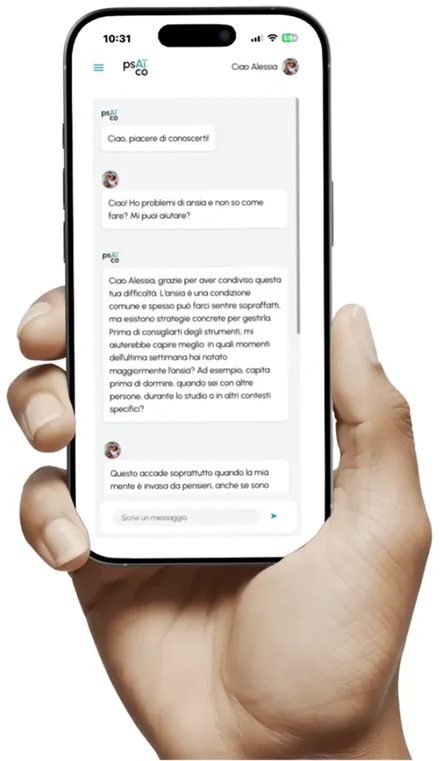
psAico is an AI assistant for psychological wellbeing, created by the psychology practice of Dr Michele Facci in Italy and built on the strategies of the cognitive behavioural approach: the same ones this article describes.
What sets it apart from a general-purpose chat are exactly the points that matter when you overthink. It is not designed to tell you you're right: if you are looking at things from only one angle, it points that out. It steers the conversation towards something to do, an exercise or a concrete step, instead of adding one more guess to the others. And it has a stated usage limit, about four hours every seven days, because a tool meant to help you out of the loop should not become the place where you go round in it.
You start from a concrete episode: what happened, which thought keeps coming back, how you are reacting. psAico does not make diagnoses and does not replace a psychologist or psychotherapist. If you are already seeing someone, you can agree with your therapist on how to use it: we cover this in our article on CBT homework between sessions.
Sources
- Stenzel KL, Keller J, Kirchner L, Rief W, Berg M. Efficacy of cognitive behavioral therapy in treating repetitive negative thinking, rumination, and worry - a transdiagnostic meta-analysis. Psychol Med. 2025;55:e31. doi: 10.1017/S0033291725000017. PMID: 39916353.
- NHS, Every Mind Matters. Tackling your worries.
- NHS, Every Mind Matters. Reframing unhelpful thoughts.
Frequently asked questions
How do I stop overthinking about someone?
Start by separating what you know from what you are imagining: the silence is a fact, the reason you give it is an interpretation. Then ask yourself whether there is a question you could ask directly, bearing in mind the context and the other person's boundaries. Rereading the chat or asking others what they think usually makes the loop longer instead of closing it.
Does asking ChatGPT for reassurance help you stop thinking about it?
In the moment, yes; in the long run, usually not. Each reassurance brings brief relief and strengthens the need to look for the next one, and with a chat that is always available the loop can get very long. It works better to use it to separate facts from interpretations and to decide on a concrete step, then close the conversation.
Are overthinking and anxiety the same thing?
No. “Overthinking” is the everyday word for thinking too much; anxiety is a broader experience, both emotional and physical. They often go together, and worry is one of the mechanisms that keep anxiety going, but overthinking is not a diagnosis in itself.
Can writing your thoughts down help?
Yes, because it puts them in order and makes them something you can examine. Keep the episode, the thought and any possible action separate. If you notice you are just rewriting the same worry, stop and pick it up again in the time you have set aside for worries.
Clinically reviewed on 11 September 2026 by Dr Michele Facci, psychologist and psychotherapist - Ordine degli Psicologi della Provincia Autonoma di Trento (Italian register of psychologists) - no. 844.